
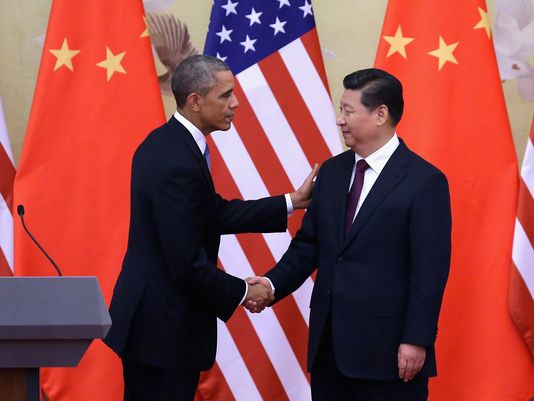
President Obama served notice Wednesday that he plans to make climate change a major theme of his final two years in office, striking a bilateral deal with China on carbon-reduction emissions that follows about nine months of secret talks.
The announcement during Obama’s trip to Beijing kindled a dispute with the incoming Republican Congress, members of which said they would resist presidential plans that undercut American industry and cost jobs.
“This unrealistic (China) plan, that the president would dump on his successor, would ensure higher utility rates and far fewer jobs,” said incoming Senate Majority Leader Mitch McConnell, R-Ky.
While critics pointed out that the China deal is strictly voluntary, administration officials said it sets the stage for a series of executive actions Obama plans to take with regard to climate change.
Obama and aides said China’s pledges to reduce greenhouse gas emissions will make it easier for nations of the world to reach a global climate change deal in 2015.
President Obama served notice Wednesday that he plans to make climate change a major theme of his final two years in office, striking a bilateral deal with China on carbon-reduction emissions that follows about nine months of secret talks.
The announcement during Obama’s trip to Beijing kindled a dispute with the incoming Republican Congress, members of which said they would resist presidential plans that undercut American industry and cost jobs.
“This unrealistic (China) plan, that the president would dump on his successor, would ensure higher utility rates and far fewer jobs,” said incoming Senate Majority Leader Mitch McConnell, R-Ky.
While critics pointed out that the China deal is strictly voluntary, administration officials said it sets the stage for a series of executive actions Obama plans to take with regard to climate change.
Obama and aides said China’s pledges to reduce greenhouse gas emissions will make it easier for nations of the world to reach a global climate change deal in 2015.
In late October, Obama dispatched a special negotiator to China: senior adviser John Podesta, who was brought into the administration largely to handle environmental issues.
American and Chinese negotiators met last week in anticipation of Obama’s visit to Beijing for an Asian economic summit.
U.S. officials pointed out that China has been criticized by its citizens over the country’s heavy pollution, putting pressure on the government to do something about climate change. In the days leading up to Obama’s arrival Sunday, the government shut down factories in and around Beijing in an effort to improve the air quality.
Congress cannot ratify or reject the agreement with China. But Republicans can try to minimize its impact by legislating away certain regulations on industry, and many pledged to do so.
McConnell, who made the administration’s alleged “war on coal” a major part of his campaign in Kentucky, said the Republican Congress would work on “easing the burden already created” by Environmental Protection Agency regulations.
House Speaker John Boehner, R-Ohio, who will have a bigger GOP majority in the wake of last week’s elections, said the China announcement “is yet another sign that the president intends to double down on his job-crushing policies no matter how devastating the impact for America’s heartland and the country as a whole.”
Sen. James Inhofe, R-Okla., soon-to-be chairman of the Senate Environment and Public Works Committee, called the agreement “a non-binding charade,” one that puts more burdens on the United States than on China.
Given a Republican majority in the Senate and House, Obama has no hope of climate change legislation. So administration officials said the president is on track to issue executive actions that deal with such items as coal ash and emissions at future power plants.
In addition, Obama administration officials said the China deal should help them pursue a global agreement to be discussed at a United Nations climate summit next year. Critics of past proposals for a global agreement have said it would be useless without the participation of China.
In announcing Wednesday’s deal with China, Obama said new climate change rules, combined with development of clean energy sources, will improve public health, grow the economy, create jobs and “put both of our nations on the path to a low-carbon economy.”
Chinese President Xi Jinping said, “We agreed to make sure that international climate change negotiations will reach an agreement as scheduled at the Paris conference in 2015.”
The political fate of that effort, in the United States at least, remains uncertain.
If countries pursue a legally binding treaty, U.S. involvement would have to be ratified by the Senate; the Senate never ratified the Kyoto Protocol reached in 1997.
