
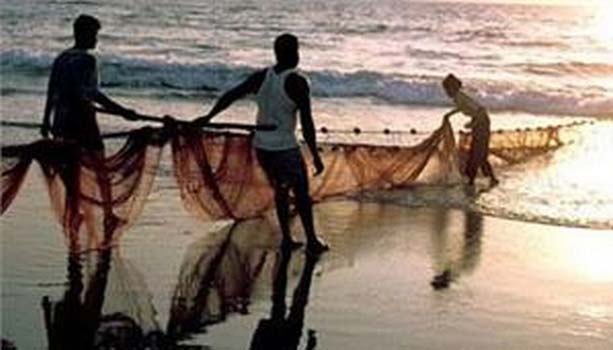
Chennai: The five Indian fishermen, who were sentenced to death on charges of drug trafficking, were released by the Sri Lankan court on Wednesday.
A few days back, Sri Lanka President Mahinda Rajapaksa had assured India that he was ready to pardon the five Indian fishermen, a statement issued by Minister Prabha Ganesan confirmed the Indian High Commission officials in Colombo.
Calling it an achievement of the Central government, BJP leader GVL Narasimha said that the announcement is heart warming and was only possible due to the efforts made by the Centre. Besides him, another BJP leader Nalin Kohli said that India’s voice taken seriously every since Modi became PM.
Meanwhile, DMK leader TKS Elangovan said that the party has already appreciated the efforts made by the Prime Minister in the release of the fisherman.
The Deputy Minister of Telecommunication and Information Technology was quoted as saying that President Rajapaksa was pushing for the withdrawal of the Indian appeal as that would drag the case for up to six months, delaying presidential pardon.
The Colombo High Court had on October 30 had sentenced the five fishermen from Tamil Nadu – P Emerson, P Augustus, R Wilson, K Prasath, and J Lanklet – to death on charges of smuggling 995 grams of heroin.
They were arrested by the Sri Lankan Navy for heroin trafficking in 2011.
The appeal filed against the Colombo High Court judgment was dismissed by a two-judge Appellate Court Bench comprising of Justices Vijith K. Malalgoda and AHMD. Nawaz, after the counsel appearing for the five fishermen said they have decided to withdraw it.
Sri Lanka, according to the Colombo Page web site, was exploring ways to free the Indian fishermen.
………………………………………………………
Political parties in TN welcome release of 5 Indian fishermen
Political parties in Tamil Nadu today welcomed the release of five Indian fishermen who were sentenced to death in Sri Lanka for alleged drug trafficking.
DMK spokesperson T K S Elangovan expressed joy over the release of the five following a presidential pardon by Mahinda Rajapaksa.
He recalled that his party chief M Karunanidhi had thanked Prime Minister Narendra Modi for taking steps to ensure that the five fishermen, hailing from Tamil Nadu and arrested in 2011, were released.
BJP’s state unit attributed the development to the efforts of Modi and External Affairs Minister Sushma Swaraj.
“But people will realise (about) those who criticised the Centre without understanding its genuine efforts and goodwill,” BJP’s state unit President Tamizhisai Sounderrajan, said.
In a statement here, she recalled the meeting Swaraj had had with a delegation of fishermen representatives in Delhi yesterday and said she had assured them that all steps were being taken for the release of the five fishermen.
She thanked Modi and Swaraj for the release of the fishermen and said that the “day is not far” when a lasting solution will be found out to the vexed issue of rivalry over fishing in the Palk Straits between fishermen of Tamil Nadu and Sri Lanka.
CPI(M) state unit secretary G Ramakrishnan, while welcoming the release, said “the credit goes to all the political parties and people of the state.”
“Almost all parties had demanded their release. My party had demanded that they should be released without any conditions. The credit (for their release) goes to the political parties and the people of Tamil Nadu,” he told PTI.
The five fishermen– Emerson, P Augustus, R Wilson, K Prasath and J Langlet — were apprehended in 2011 and sentenced to death by the Colombo High Court on October 30 for alleged drug trafficking.
President Rajapakse had commuted their death sentence after Modi took up the matter with him even as India withdrew an appeal in that country’s Supreme Court against the death penalty to facilitate the former commute the verdict.
The state’s ruling AIADMK and other political parties in the state had vehemently protested against the conviction and subsequent awarding of death sentence, alleging that the drug case was a ‘foisted one.’ All of them had sought the Centre’s intervention to secure their release.
