
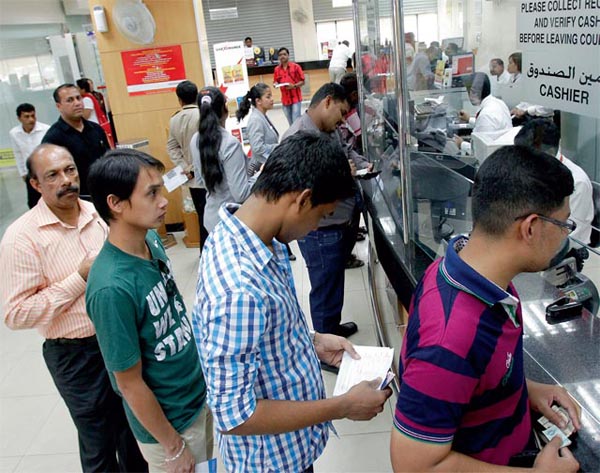
Indian expats make the most of low money transfer charges
Dubai: Encouraged by the low cost of remitting money to India and the current strength of the UAE dirham over the Indian rupee, wealthier non-resident Indians (NRIs) are remitting big amounts for investment back home, according to a recent white paper commissioned by Friends Provident International (FPI) and published by the Economist Intelligence Unit (EIU).
The white paper and documentary video released by FPI, titled ‘UAE Expatriates and the Bottom Line’, reveal the hidden costs that expatriates living and working in Dubai and Abu Dhabi may face. The survey findings show how important financial planning is for expatriates if they want to reap the benefits of working in a tax-free environment, and avoid the pitfalls of hidden costs and high prices.
In stark contrast with other expatriate nationalities in the UAE, NRIs are one of the most financially prudent expatriate groups. Research published last year found that NRIs put aside an average of 70 per cent of their disposable income for investment and saving.
Marcus Gent, managing director, Middle East and rest of the world, FPI, said: “Much has been said about the UAE’s many spending temptations and the fact that expatriates are not saving enough for their retirement, or for other important events in their lives. We see that non-resident Indians, be they high or low-income earners, have incredible financial discipline and their culture of saving makes them a great case study, highlighting the value of careful financial planning.”
Much of the money remitted is used for family support. India’s less developed pension system, compared with Europe or North America, for example, drives expatriates towards supporting their parents and children rather than starting a retirement plan for themselves. Over 80 per cent of Indians in the UAE have between two and five dependents to support, many of these back in India.
Culturally, Indians consider the education of their children and paying for their wedding as fundamental financial planning requirements. Some 90 per cent invest heavily in their children’s education.
Remitting money from the UAE to India is less expensive than from other locations. Specialist money transfer firms such as UAE Exchange, Al Ansari, Emirates NBD and Western Union charge fixed fees as low as Dh15 on transfers to India and the Philippines.
For UK expatriates, the fee can be two or three times higher when remitting to their home country. While there is some variation — fixed rates of up to Dh80 can apply for express payments — the average cost of sending $200 to India from the UAE is about $5. Sending the same amount to India from Australia costs three times as much.
Gent added: “Earning in dirhams could translate favourably into a comfortable retirement, especially given the current weakness of the Indian rupee. For investment opportunities, India is an attractive prospect for the savvy, better-off white-collar Indian investor — and remittance and investment flows from the UAE to India clearly confirm a continued and increasing appetite.”
“However, NRIs should consider carefully while planning their savings — in particular the preference for investing in gold and property. While gold can be a good diversifier — because it is negatively correlated to many mainstream asset classes — it is important that any portfolio is diversified, both geographically and by asset class. That way it is more likely to generate a less volatile return,” he added.
Indians, by far, form the largest foreign-born community in the UAE, and an increasing number of professionals are relocating to the country. The Indian embassy in Abu Dhabi lists over 40 major Indian companies with offices in the UAE, the majority operating in highly skilled technology or finance sectors.