

Every human being at one stage or other bound to react, over re-act and to commit mistakes when taking any decision in their life. This is may be due to their overconfidence, over and under estimation, ego, ignorance or negligence. There are many factors to name.
A slight ignorance, lapse or negligence from our part in taking our whether it is major or minor decisions, evaluations, selections of any things, may ultimately land in an unknown, embarrassing situation, which in turn causes a state called regret at later stage.

Regret is common phenomenon occurring everywhere by each and every human being, every company, industries, whether it is a small or big, and every household and in every fields of our life regardless of the status, wealth, money, qualification, profession and intelligence. It does not spare anybody.
If we give any room for any regret to happen at any stages of our day to day life, we start pondering over the act we committed such as, that decision was wrong, this decision was wrong, it could have been done that way, this could have been done this way, we shouldn’t have done it, it was wrong, and this was wrong bla!! Bla etc!! at later stage.
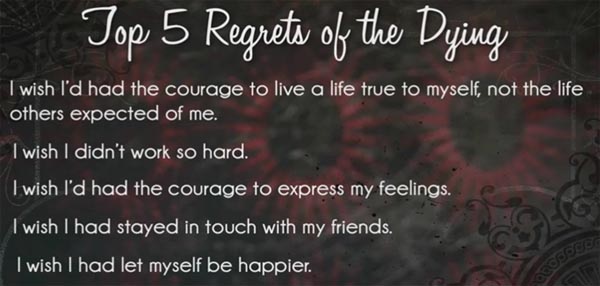
Regret is the negative emotion experienced when learning that an alternative course of action would have resulted in a more favorable outcome. The theory of regret aversion or anticipated regret proposes that when facing a decision, individuals may anticipate the possibility of feeling regret after the uncertainty is resolved and thus incorporate in their choice their desire to eliminate or reduce this possibility.
Regret is a negative conscious and emotional reaction to personal past acts and behaviors. Regret is often expressed by the term “sorry” whereas “I’m sorry” can express both regret and sympathy. Regret is often a feeling of sadness, shame, embarrassment, depression, annoyance, or guilt, after one act in a manner and later wishes not to have done so. That is always that “ One stupid mistake, that Changes Everything”.

Regret is distinct from guilt, which is a deeply emotional form of regret — one which may be difficult to comprehend in an objective or conceptual way. In this regard, the concept of regret is subordinate to guilt in terms of its emotional intensity. By comparison, shame typically refers to the social (rather than personal) aspect of guilt or (in minor context) regret as imposed by the society or culture (enforcement of ethics, morality), which has substantial bearing in matters of (personal and social) honor.
It is also distinct from remorse, which is a more direct and emotional form of regret over a past action that is considered by society to be hurtful, shameful, or violent. Unlike regret, it includes a strong element of desire for apology to others rather than an internal reflection on one’s actions, and may be expressed (sincerely or not) in order to reduce the punishment one receives.

Regret can describe not only the dislike for an action that has been committed, but also, importantly, regret of inaction. Many people find themselves wishing that they had done something in a past situation.
There are extremely specific models of regret mostly in economics and finance under a new field called behavioral economics. Of these, the most clearly emotional is buyer’s remorse, also called buyer’s regret. Other examples include regret aversion or more generally, regret (decision theory).

Existential regret has been specifically defined as ‘a profound desire to go back and change a past experience in which one has failed to choose consciously or has made a choice that did not follow one’s beliefs, values, or growth needs’.
People who suffer from antisocial personality disorder and dissocial personality disorder are incapable of feeling regret or remorse.

Meta-analysis involving what we regret most has concluded that overall, Americans regret choices regarding their education the most. Subsequent rankings then include decisions about career, romance, and parenting. Education was the forerunner of regret in a number of different studies. This finding can be attributed to the opportunity principle.
Opportunity principle defines people’s biggest regrets as those marked by the greatest opportunity for corrective action. When the opportunity to improve conditions is nonexistent, cognitive processes proceed to mitigate regret. Education is the forerunner of what we regret most because it is seen as something where circumstances could be changed: “In contemporary society, education is open to continual modification throughout life. With the rise of community colleges and student aid programs in recent decades, education of some sort is accessible to nearly all socio-economic groups.”
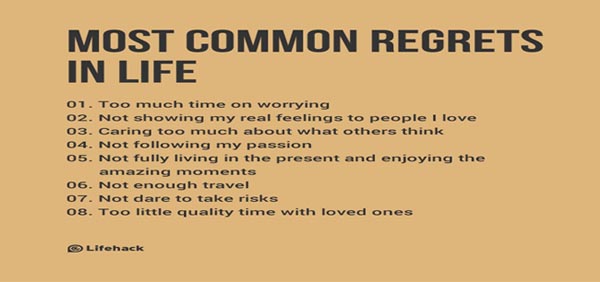
Regret pushes people toward revised decision making and corrective action that often bring improvement in life circumstances. A study measured regret in accordance to negative reviews with service providers. It was concluded that regret was an accurate predictor of who switched providers. Regret can be seen as an evolutionary development. As more intense regret is experienced, the likelihood of initiating change is increased. Consequently, the more opportunity of corrective action available, the larger the regret felt and the more likely corrective action is achieved. People learn from their mistakes.

In response to the opportunity principle, the lost opportunity principle directly opposes its views. The lost opportunity principle states that regret should intensify, not diminish, when people feel that they could have made better choices in the past but now perceive limited opportunities to take corrective action in the future.
“People who habitually consider future consequences (and how they may avoid future negative outcomes) experience less, rather than more, intense regret after a negative outcome.” This principle offers another reason as to why education is the most regretted aspect in life. Education becomes a more limited opportunity as time passes. Aspects such as making friends, becoming more spiritual, and community involvement tend to be less regrettable which makes sense because these are also aspects in life that do not become limited opportunities.

As the opportunity to remedy a situation passes, feelings of hopelessness may increase. An explanation of the Lost Opportunity Principle can be seen as a lack of closure. Low closure makes past occurrences feel unresolved. Low closure is associated with “reductions in state self-esteem and persistent negative affect over time”. Because high closure is associated with acceptance of lost opportunity, low closure is then associated with the realization and regret of lost opportunity.
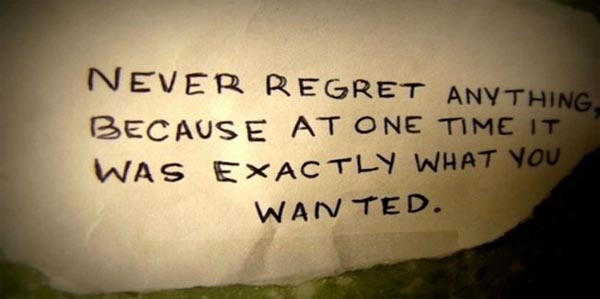
The lost opportunity principle suggests that regret does not serve as a corrective motive (which the opportunity principle suggests). Instead, regret serves as a more general reminder to seize the day. Feeling regret will spur future action to make sure other opportunities are taken so that regret will not be experienced again.

People appear to overestimate how much regret they will feel in the future. In particular, anticipated regret (how much regret one thinks one will feel) appears to be overestimated for actions and choices. This appears to be, in part, due to a tendency to underestimate the extent to which people attribute bad outcomes to external factors than to internal factors (i.e., themselves).
5 Tips For Making Good Decisions To Avoid Regret Later On
1. Face the truth bravely.
People sometimes flee from the truth, because it’s scary or unpleasant. Instead of making good decisions based on the reality of a situation, people procrastinate, hide, or delay taking real action. That’s precisely what I did when I decided to hide in a bottle.
I now have a tattoo (yes, therapists can have tattoos) that reads: “Face Your Truth—Take Your Freedom.” It’s a formula for making good decisions. You can only truly be free by acknowledging the truth, however difficult, and dealing with it, rather than burying your head in the sand. You’ll thank yourself later on for being brave.
2. Look at the long-term.
It is easy to make quick decisions that seem to work in the short-term; but what really counts is the impact of a decision in the long-term. Don’t go for quick fixes—look at what really works over time. If I had done this, I might never have lost my pancreas, my sanity, and a decade of my life.
Ask yourself whether this decision is a real solution with beneficial long-term consequences. Good decisions sometimes bring pain in the short-term, but that’s not the rest of your life. It’s always worth temporary pain and struggle to make good decisions you won’t regret.
3. Do a value-tally.
The decisions we most regret are usually those that don’t match up with what we value. As my later career as a therapist and writer shows, what matters to me is being able to help others, to express myself, and to make a difference. Drinking my way into oblivion was no way to live the life that I wanted.
It’s never a good idea to do something that clashes directly with your own values, because it will make you very unhappy. Good decisions match your values, and allow you to lead a life that fulfils you.
4. Consider what’s at stake.
Good decisions are those which give us benefits without losing us anything important. When I chose to drink to get through life at university, I hadn’t factored in that if it didn’t work out, that was one thing I would really regret screwing up.
And of course, I did screw it up. I was in and out of university for years between ill health, suicide attempts and generally losing the plot. I try not to regret anything these days, because it’s a wasted emotion. But of all the things I look back on the most sadly, it’s the fact that I had to jettison university permanently in the end. I will most likely never again get a shot at something I loved so dearly. Good decisions are those which don’t burn bridges you can’t rebuild.
5. Do the death-bed test.
A great way of making good decisions is to ask yourself if, on your death bed, you would regret anything about your choice. This applies as much to not doing things as to doing them. If you decide never to have a shot at improving yourself, starting your own business, or writing a book, would you look back on your life and wish you’d just given it a go?
The greatest regret usually comes not from failure, but from not having tried at all. I don’t regret much of my life now, because I eventually made good decisions and turned my life around before I reached my death bed—although it was a close call. No matter how hard or scary the work is, the decision to try for all you are worth is better than looking back with regret at things you never even attempted.
Shekar Moily



Comments are closed.